

Medical Adverse Events Act
- Scope of procedure
- This procedure applies at BiaVita Polska S.A. in Białystok - Augustów Health Resort Sanatorium, 3/5/7 Zdrojowa St., 16-300 Augustów.
- The procedure concerns reporting adverse events that may occur while healthcare services are provided.
- Purpose of procedure
The procedure for reporting adverse events arising while healthcare services are provided at BiaVita Polska S.A. in Białystok - Augustów Health Resort Sanatorium is part of the internal quality and safety management system. Its purpose is to:
- Monitor adverse events.
- Standardize adverse-event reporting rules.
- Define rules for root-cause analysis of adverse events.
- Identify the risk of adverse events and manage this risk during healthcare services.
- Prepare corrective-action recommendations to prevent similar adverse events from recurring.
- Key terms
Adverse event – an event occurring during, or resulting from, the provision or failure to provide healthcare services, causing or potentially causing a negative effect on a patient's health or life, in particular death, injury or ill health, disease, life-threatening condition, hospitalization or its extension, or fetal bodily injury or ill health; an event whose outcome is the expected result of properly provided healthcare is not an adverse event. Adverse events should not be confused with the natural progression of disease or foreseeable therapeutic complications.
Risk - a combination of the likelihood of an event and its consequences. Clinical risk management is a key element of the quality management system (PN-EN ISO 15224:2013 – Healthcare services – Quality management systems).
Risk assessment - ensures that the likelihood of someone having an accident or becoming ill due to workplace hazards is as low as possible. Most importantly, it identifies significant workplace hazards and whether they are prevented using appropriate and sufficient control measures.
Interface - the point of contact between a person and a machine/device. A proper interface should ensure error-free receipt of information, without the possibility of error, and unambiguously correct performance of actions.
Reporting and Learning System (RLS) - a reporting and learning system. Reporting should be voluntary and confidential; it may be independent or integrated with a system for recording complaints, requests or patient claims.
Safety Assessment Code (SAC) - safety assessment code matrix.
Root-cause analysis - the process of explaining why an adverse event occurred and the circumstances that may have contributed to it.
- Types of adverse events
- Related to medical devices and equipment (information and control interfaces):
- lack of current technical inspections,
- unavailable or limited equipment access,
- equipment failure,
- illegible device panel,
- non-ergonomic arrangement of medical-equipment buttons or handles,
- bodily injury caused by faulty operation or use of equipment,
- other.
- Related to organization of medical staff work:
- incorrect qualification for treatment,
- wrong identification of the treatment site or operated limb,
- incorrect dose during physiotherapy treatment,
- physiotherapy treatments performed in the wrong order (contrary to professional standards),
- bodily injury caused by an incorrect procedure or incorrectly performed physiotherapy procedure,
- failure to detect venous thromboembolism (deep-vein thrombosis) before physiotherapy treatments and procedures,
- other.
- Related to treatment and pharmacology:
- wrong diagnosis due to:
- misinterpretation of laboratory results,
- incorrect radiology report,
- incorrect histopathology report,
- ordering an inappropriate treatment,
- patient or staff injury from sharp instruments during treatment, potentially causing blood-borne infection and, consequently, infectious or invasive disease,
- incorrect performance of a medical procedure,
- bodily injury caused by a medical procedure,
- medication administration error, including:
- wrong medication,
- incorrect dose,
- wrong patient identification,
- incorrect administration time,
- unjustified delay in administration,
- incorrect route of administration,
- incorrect preparation method (e.g. wrong solvent)
- events related to medication expiry,
- other.
- wrong diagnosis due to:
- Related to patient care:
- wrong patient identification,
- wrong procedure identification,
- failure or delay in providing care,
- pressure ulcers caused by inadequate care,
- catheter-related bloodstream infection,
- sanatorium-acquired infection,
- sepsis,
- food poisoning,
- allergy-related anaphylactic shock,
- other.
- Related to unexpected events:
- suicide attempt,
- suicide,
- patient fall at the facility,
- unauthorized departure of a patient from the Sanatorium
- patient use of stimulants or narcotics,
- patient death,
- drowning or near-drowning,
- other.
- Related to non-compliance with procedures:
- performing treatment without the patient's signed informed consent,
- providing medical information to an unauthorized person,
- other.
- Related to work organization and management (standardization):
- lack of standardization of devices, terminology, procedures or installations,
- allowing persons without required qualifications to work (without the right to practice a medical profession),
- incorrect patient identification; lack of legible identifiers,
- insufficient staffing,
- poor staff selection quality,
- poor work planning (overtime, night or shift work, allowing an employee working in several places to work without adequate daily rest),
- inability to introduce teamwork,
- poor communication,
- other.
- Related to medical devices and equipment (information and control interfaces):
- Responsibility:
- Under the Act of 16 June 2023 on quality in healthcare and patient safety, Journal of Laws 2023 item 1692 (Art. 19(1)), the person responsible for operating the internal system is the Manager of the entity conducting medical activity within the meaning of Art. 2(2)(1) of the Act of 15 April 2011 on medical activity, hereinafter the “person responsible”.
- The person responsible shall:
- conduct root-cause analyses of adverse events,
- provide the resources and information needed to properly monitor the quality and safety of healthcare services,
- prepare internal quality and safety management system documents specifying the rules, procedures, methods and job descriptions referred to in Art. 18(1) of the Act of 16 June 2023 on quality in healthcare and patient safety, Journal of Laws 2023 item 1692.
- Reporting an adverse event
The purpose of reporting adverse events is to improve the safety of healthcare services by identifying situations and circumstances that pose risks to patients, and by taking action to prevent or control those risks. Such solutions should be implemented to eliminate or limit the occurrence of adverse events in the future and subject them to thorough analysis.
Staff of the entity conducting medical activity should understand the responsibility involved in properly identifying and reporting all adverse events to the person responsible that occurred at the entity, regardless of their severity or likelihood of recurrence.
- An adverse event may be reported by:
- medical and non-medical staff, immediately after the adverse event occurs or is identified,
- witnesses to the adverse event,
- patients, patients’ families, caregivers,
- Reporting methods:
- directly, orally to the person responsible for adverse events, previously authorised by the Head of the Entity. The authorised person is required to complete the adverse event report form (Appendix 1) or provide the reporting person with such a form for completion.
- on the paper adverse event report form (Appendix 1), available at the main reception of Sanatorium Uzdrowiskowe Augustów or downloaded from the website www.sanatorium.augustow.pl
- completed paper adverse event report forms (Appendix 1) are collected in a dedicated box placed at the main reception of Sanatorium Uzdrowiskowe Augustów or sent by post to:
Sanatorium Uzdrowiskowe Augustów, 3/5/7 Zdrojowa St., 16-300 Augustów
- send information about the adverse event to the email address: zn@biavita.pl. In response to the report, the authorised person will send the reporting person the adverse event report form (Appendix 1), asking them to complete it.
- Procedure
Reporting and Learning System (RLS) – a reporting and learning system. Under the RLS, the approach to safety and quality in healthcare involves identifying systemic risks (i.e. at every stage of healthcare service delivery) to which patients are exposed, reducing risks and improving patient outcomes by implementing risk management systems.
- Reporting an adverse event.
- Registering and collecting detailed data and information about the event.
- Mapping data and information about events.
- Identifying and classifying adverse events based on report forms.
- Root cause analysis.
- Determining the root causes of the event and drawing conclusions.
- Recommendations and report.
- Providing information to medical and other staff.
The RLS must not be used to identify and stigmatise people involved in an event. The system is to be confidential and voluntary. RLS operating principles:
- The reporting person’s data should be known only to the person responsible for reporting. The reporting person may also remain completely anonymous, without disclosing their personal details.
- Adverse event reporting should focus on finding corrective actions, without personalising the issue or seeking those responsible.
- Reporting an adverse event, analysing its root causes, assessing the event and classifying it may not constitute grounds for disciplinary liability, liability for damage caused as a result of making the report, or liability for infringing the rights of others or obligations stipulated by law.
- After receiving an adverse event report, the person authorised by the Head of the Entity registers the report, collects information about its circumstances and participants, conducts a preliminary analysis, formulates conclusions and notifies the Head of the Entity.
- Based on the report, conclusions are drawn and recommendations are formulated to take specific action to prevent the irregularity from recurring.
- Conclusions are drawn without determining fault. The report is approved by the Head of the Entity.
- Root cause analysis
Root cause analysis is the process of explaining the causes of an adverse event and the circumstances that may have contributed to its occurrence. Root cause analysis does not assess the fault or liability of people involved in the adverse event.
Root cause analysis aims to:
- collect information about the identified causes and circumstances of the adverse event, its participants and its consequences for them;
- analyse the information referred to in point 1 and formulate conclusions based on it;
- formulate recommendations for action to improve the quality and safety of healthcare services, aimed at preventing the adverse event from recurring.
- Risk identification
Adverse events are assigned to one of the risk categories related to quality and safety, based on the SAC safety assessment matrix:
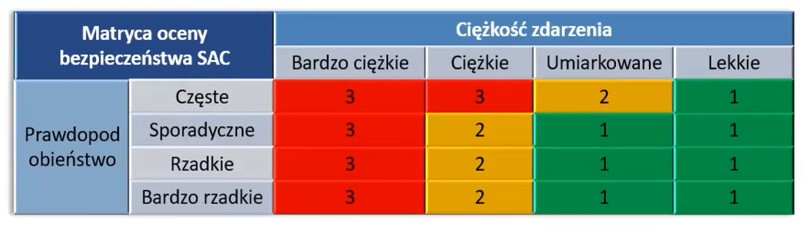
Figure 1 SAC safety code matrix
The risk category for a given adverse event is determined according to the following point scale:
- 3 points – high risk – an adverse event meeting the criteria for a very severe event or a severe and frequent event, in accordance with the criteria and probability assessment,
- 2 points – medium risk – a severe and occasional, rare or very rare adverse event, or a moderate and frequent event,
- 1 point – low risk – a moderate and occasional, rare or very rare adverse event, or a minor event.
Adverse events are assessed according to severity using the following criteria:
- a very severe event includes:
- death; or
- significant and permanent bodily injury or health impairment resulting in the loss or impairment of sensory, motor, physiological or intellectual function, unrelated to the conditions underlying the provision of healthcare services or the patient’s state of health;
- a severe event includes:
- significant bodily injury or health impairment resulting in a temporary limitation of sensory, motor, physiological or intellectual function, unrelated to the underlying condition or the patient’s state of health; or
- transfer to an intensive care unit, dialysis unit, or intensive supervision ward or room; or
- the need for surgical intervention;
- a moderate event includes:
- an extended stay in the healthcare entity; or
- deterioration of the patient’s health requiring transfer to a higher level of care;
- a minor event includes events other than those specified in points 1–3 that do not cause harm to health.
Adverse events are assessed according to the likelihood of occurrence as:
- frequent – the event is likely to occur several times a year,
- occasional – the event is likely to occur once or twice a year,
- rare – the event may occur once every two years,
- very rare – the probability of the event occurring is very low, less than once every two years.
- Risk analysis and management
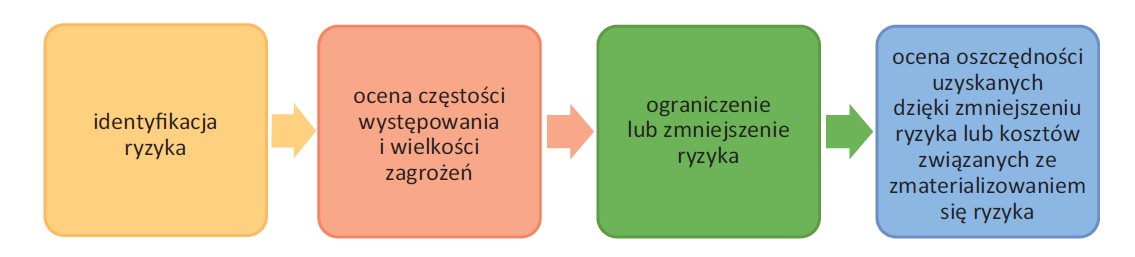
Figure 2 Four-stage risk management procedure
Risk analysis is prepared based on root cause analysis, using the received adverse event forms.
Forms may reach the medical facility:
- on a paper form placed at the main reception of the Sanatorium; or
- using a form downloaded from the website and sent by post to: Sanatorium Uzdrowiskowe Augustów, 3/5/7 Zdrojowa St., 16-300 Augustów or
- sent by email in response to a report to zn@biavita.pl.
- Person responsible for adverse events at Sanatorium Uzdrowiskowe Augustów
The Head of the Entity, as the responsible person, authorises physician Paweł Karaś to act as the person responsible for adverse events.
- Appendices
- Adverse event report form – Download file
- Procedure for reporting adverse events - Download file

Holidays by the Lake in Augustów
- Breakfast and Dinner
2-day Regenerative Stay
- min 2 days
- Breakfast and Dinner
Medical Stay 5 days
- min 4 days
- Breakfast and Dinner
Health Stay PREMIUM
- min 6 days
- Breakfast and Dinner
Autumn at the SPA
- min 2 days
- Breakfast and Dinner
Spa Package for Two
- min 2 days
- Breakfast and Dinner
Christmas at SPA Augustów
- min 2 days
- Breakfast and Dinner
Copy_Christmas at SPA Augustów
- min 5 days
- Breakfast and Dinner
Copy_New Year's Eve in a wonderful place
- min 5 days
- Breakfast and Dinner
New Year's Eve in a wonderful place
- min 2 days
- Breakfast and Dinner